About the project
The overarching goal osf the study is to establish foundations for a comprehensive reference map of the uterus before and after normal term labour. This is essential to underpin future efforts to understand mechanisms driving preterm labour and develop effective preventative treatments.
Addressing key questions from the Borne Grant call, our BUMP feasibility study has focused on:
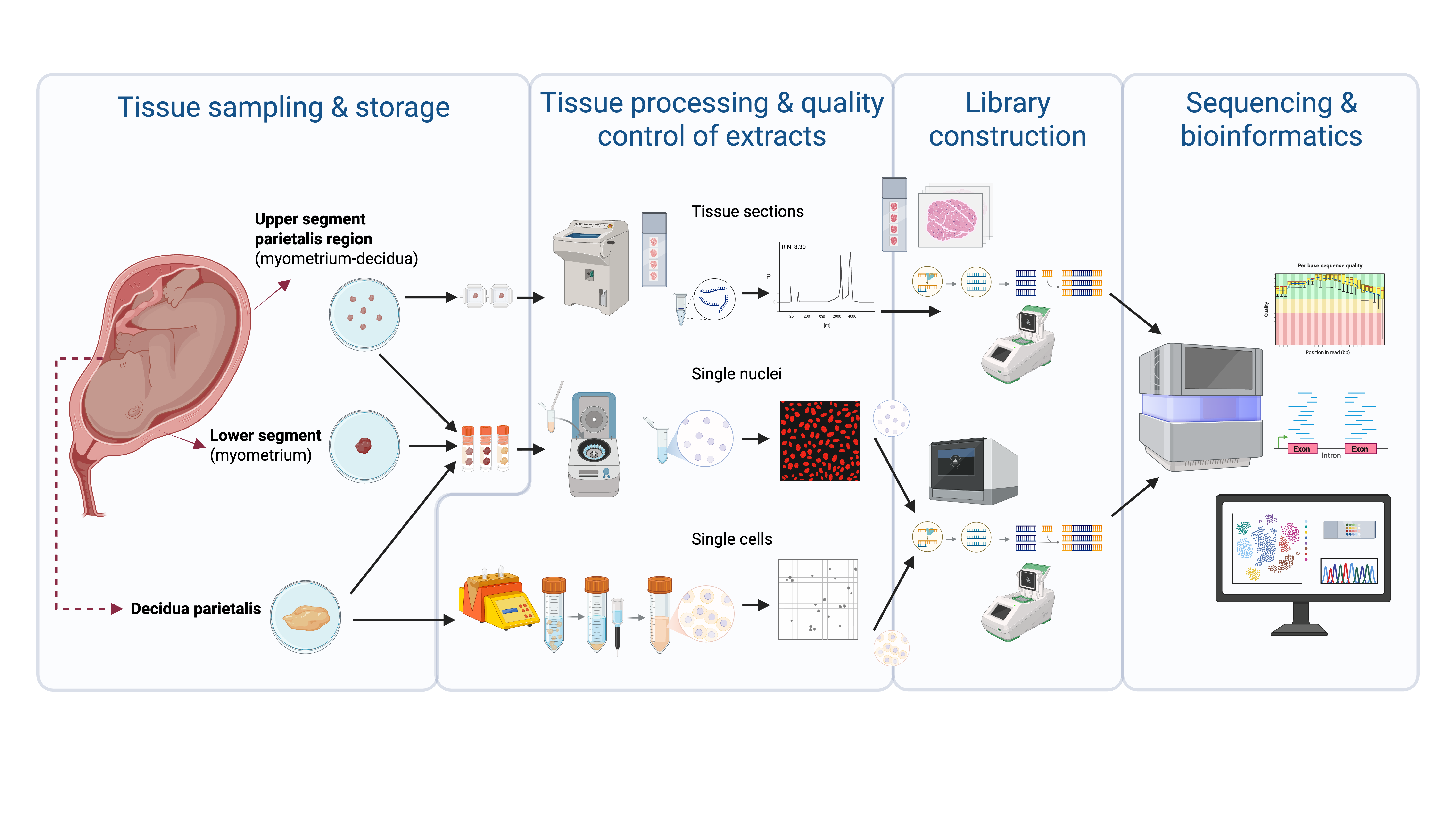
Establishing a biobank with refined, tested, and standardised protocols for collecting, processing and storing maternal and placental samples, with associated clinical phenotypes.
Developing and validating protocols for single-cell, single-nucleus RNA sequencing, and spatial transcriptomic profiling of reproductive tissues.
Investigating proteomics approaches to understand how differences in protein expression may influence cellular phenotype.
Analysing data to create a repository of reproducible, user-friendly, and shareable bioinformatics pipeline and statistical approaches and developing a community portal for SOPs, analysis pipelines, and data sharing.
Use the Feasibility study outcomes to begin to address biological questions of relevance to uterine function in labour.
What we have achieved so far
We have built an effective, multidisciplinary team across multiple institutions, and shared progress with the Borne collaborative.
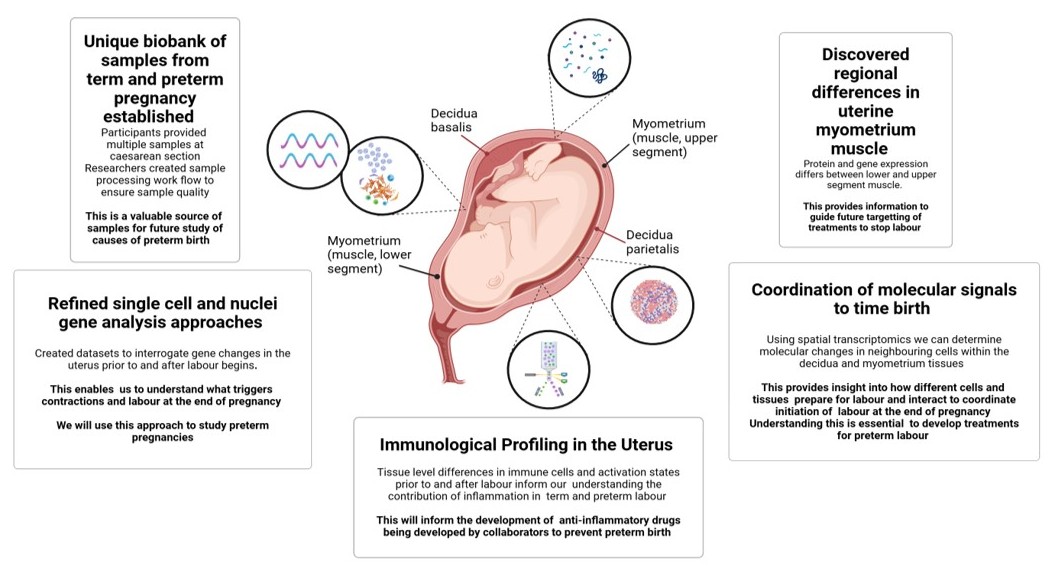
- Sample resource and protocols: We have established a unique biobank of rigorously collected reproductive tissues (including paired samples from ~5 distinct regions of the uterus) and associated clinical data from term and preterm pregnancies, We have defined criteria for labour states at term (not in labour, early labour, active labour). Validated protocols for sampling, processing, and storage can now be shared to ensure consistency across sites and expand tissue and data collection. Instructional videos are being developed to support clinicians. Samples, our proteomics platform, protocols, and analystical approaches have supported a Borne funded PhD student.
- Single-cell and single-nucleus genomics: We refined experimental approaches and generated proof-of-principle datasets to interrogate molecular changes before and after labour onset, enabling us to start identyfying triggers of uterine contractions and labour. These methods are primed to be applied to preterm pregnancies.
- Regional tissue differences in the myometrium: We quantified >6,000 proteins and identified region-specific differences in protein expression between upper and lower uterine muscle, and between decidua and myometrium, providing new information on region-specific functionality in the uterus. This complements allied work (funded by Borne/AMR) where we we have established tissue-enriched proteome features of myometrium and maternal and placental blood vessels.
- Immunological profiling: We have started to profile uterine tissue-level differences in immune cells before and after labour, improving our understanding of inflammation in term and preterm labour. These insights will inform the development of anti-inflammatory therapies being pursued by collaborators.
- Coordination of molecular signals and spatial context: Using spatial transcriptomics in decidua and myometrium, we have begun to map molecular changes in neighbouring cells to reveal how distinct cell types prepare for and coordinate labour initiation. Understanding this crosstalk is essential for developing treatments to prevent preterm labour.
- Community Portal and Bioinformatics: Raw data is will be deposited in open-access repositories (MassIve; Geo) for community analysis. In addition, we have established this dedicated Bump study web-portal and a GitHub repository. These resources establish robust foundations for transparency, reproducibility, and collaborative data sharing.